
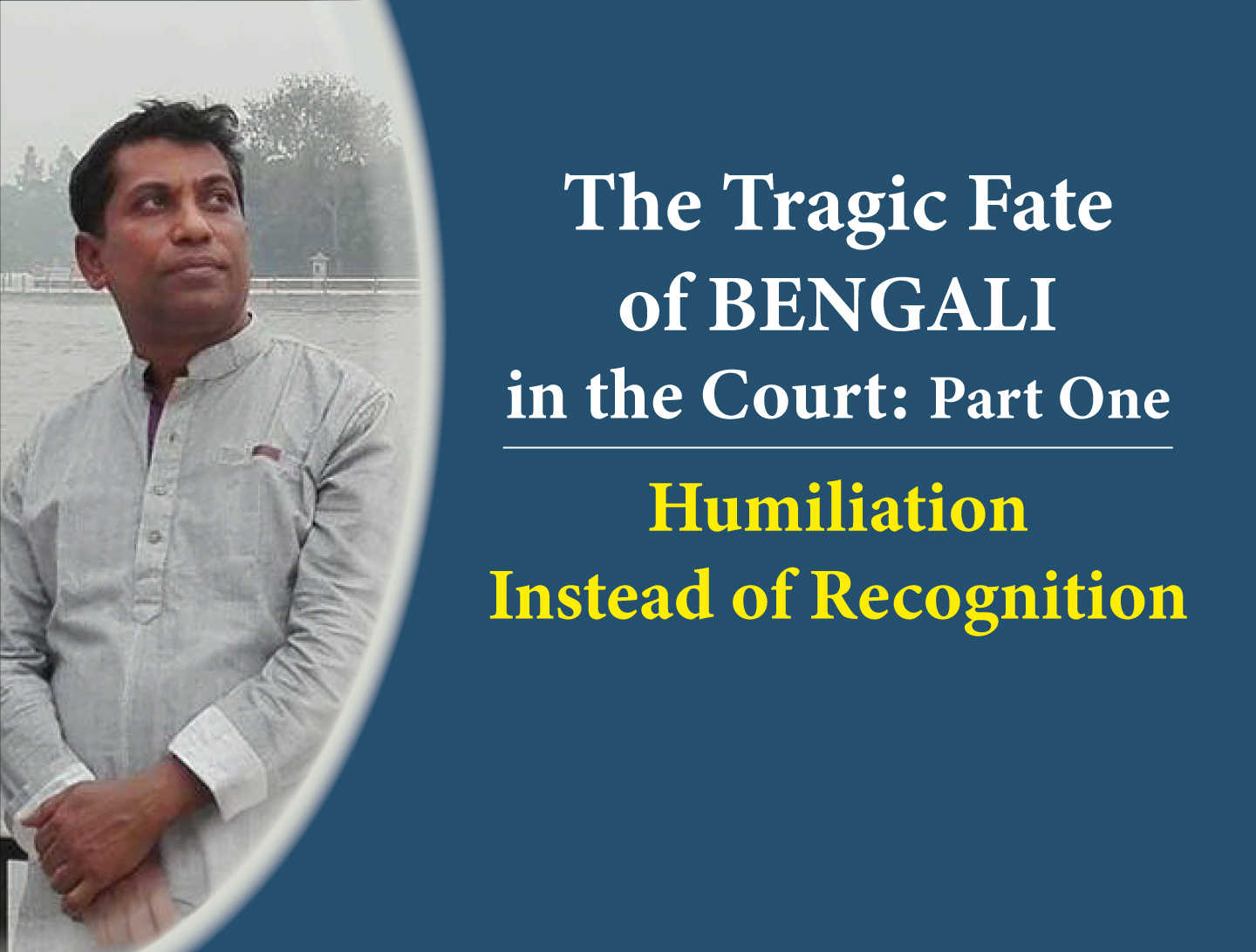
When it is said—”This is not a Bengali court, this is an English court!”—when fluent English is spoken in court to amuse the litigants and judges, satisfy the clients, and the blue-blooded barrister feels an overwhelming thrill deep in his heart—then our mother tongue, Bengali, which has endured thousands of years of struggle, shrinks into a corner of this discriminatory state and collapses in despair.
In the court premises and corridors, alienated litigants can be seen sitting with sorrowful and dejected faces. Can the state comprehend their pain? If court verdicts were delivered in their mother tongue, the common people could access justice more easily—this fact is well known to many in the legal system. But has anyone taken the laborious step to make this happen? And has the International Mother Language Institute achieved any visible success so far?
Those whose spines are infested with the termites of rituals and formalities suddenly become emotional about implementing Bengali in all spheres every February. We have secured international recognition for the Bengali language and established February 21st as International Mother Language Day— shall we consider this as our most significant achievement? Is this where all the attainments end?
Doesn’t our so-called intellectual elite society consider English as divine wisdom, far superior to Bengali? If you can speak a couple of lines of English, you’ll land a prestigious job here. To become a first-class officer of the Republic, all you need in the BCS oral exam is to speak English, and voilà, a top position is yours.
When the English eliminates all the difficulties, where does the power of Bengali stand? Where is the chant of awakening to exorcise the ghosts from the colonial ritual fields? Bengali in law and courts— is it merely a futile atonement for the common people’s daily sins?
Bengali in Court: Reality and Negligence
As a journalist covering legal affairs, I have observed that some judicial officials object to translating “Chief Metropolitan Magistrate” and “Chief Judicial Magistrate” into Bengali as “Mukhya Mohanagar Hakim” and “Mukhya Bicharik Hakim”. They even express their anger about this to journalists in their chambers. However, the High Court has issued a directive to use Bengali in courts. Needless to say, this directive was given in the very month of the Language Movement!
There is an interim order stating that the Bengali language should not be distorted in radio and television broadcasts. But what is the reality? Nowadays, on February 21st, 8th Falgun, the Morning Procession (Prabhat Feri) to the Shaheed Minar has turned into a frivolous festival. Instead of mourning, people celebrate with balloons and sky lanterns. Why does no one truly understand the significance of Language Martyrs’ Day? Why does no one reflect on why the martyrs sacrificed their lives and shed their blood?
Moreover, what about pronunciation? Bengali sentences are increasingly mixed with English words, creating a hybrid language. We are well aware of how the younger generation is adopting this trend. How many lawyers in the court premises can speak and write proper, standard Bengali? The answer is not unknown to us!
There is Legal Recognition but Zero Implementation
A former Chief Justice, when he served as a Justice in the High Court Division, began writing judgments in Bengali on February 11, 2007. According to media reports, he wrote nearly 200 verdicts in Bengali. Even after becoming Chief Justice, he continued to write judgments in Bengali. Yet, in the highest court, Bengali still hasn’t been bestowed with the respect it undoubtedly deserves.
Neglected and abandoned, the sorrowful Bengali alphabet is fading day by day. The hollow praises and empty promises of the state render it colourless year after year, much like Bangladesh herself, who is burdened with the crown of deprivation.
Article 3 of the Constitution clearly states: “The state language of the Republic is Bengali.” However, the tragic irony is that Bengali has yet to be fully implemented at all levels.
The Language Movement: History and Reality
The history of the Language Movement is not unknown to anyone. The Language Movement of ’52 is no longer confined to the national sphere; it has gained international recognition. The 21st of February is now observed as International Mother Language Day worldwide. Many countries have established their mother tongue in courts. Their judges conduct trials and deliver verdicts in their mother tongues.
However, in Bangladesh–the country where people sacrificed their lives for the language, where blood was shed for the rights of their mother tongue–Bengali, their mother tongue, is still neglected in its courts!
To fully and effectively implement Article 3 of the Constitution, the ‘Bengali Language Implementation Act’ was enacted in 1987. According to Section 3 of this Act, all legal proceedings must be conducted in Bengali, including official documents, correspondence, pleadings, and both direct and cross-examinations in courts. Any application or appeal submitted in a language other than Bengali will be considered illegal and invalid. If any government officer or employee violates this law, their actions will be deemed misconduct.
According to Section 3(3) of the Act, if any officer or employee violates this law, it will be considered misconduct under the Government Servants (Discipline and Appeal) Rules, and action will be taken against them accordingly.
As per the Government Servants (Discipline and Appeal) Rules, 2018, the maximum penalty for misconduct is dismissal from service.
But in reality, has anyone ever been penalised, even with the mildest punishment of a simple rebuke, for violating this law? There is no such precedent. No one is compelled to comply with this law. The dominance of English continues in the administration, and the courts are no exception. There are no objections anywhere!
Legal Complications Regarding Language Use in Courts
The entire situation is a tangled mess! Currently, language usage in courts is arbitrary and unregulated. English is customarily mandatory in the highest courts, while a mix of Bengali and English is used in the lower courts.
Legal experts suggest that due to the failure to amend Section 137 of the Code of Civil Procedure, the use of Bengali in the higher courts cannot be ensured.
Section 137(1) states, “ The language which, on the commencement of this Code, is the language of any Court subordinate to the High Court Division shall continue to be the language of such subordinate Court until the Government otherwise directs.”
Section 137(2) states, “ The Government may declare what shall be the language of any such Court and in what character applications to and proceedings in such Courts shall be written.“
Section 137(3) states, “ Where this Code requires or allows anything other than the recording of evidence to be done in writing in any such Court, such writing may be in English; but if any party or his pleader is unacquainted with English a translation into the language of the Court shall, at his request, be supplied to him; and the Court shall make such order as it thinks fit in respect of the payment of the costs of such translation.“
There have been many discussions on state reforms, including constitutional changes after the July mass uprising, but the issue of implementing Bengali language in the courts has never been raised—perhaps due to the limitations of the interim government.
In light of the ‘Bangla Language Implementation Act, 1987’, the Law Commission recommended in 2011 that the use of Bengali must be ensured in all court proceedings. However, this recommendation has not yet been implemented. Although a few High Court judges have begun writing verdicts in Bengali, most judgments are still written in English.
In a writ case of 1991, the High Court ruled that the use of English in subordinate courts under Section 137(2) of the Code of Civil Procedure is legally valid, which conflicts with the Bangla Language Implementation Act.
Steps Taken for the Development of the Bengali Language
Mostly in every year, various circulars and decisions are issued regarding the official use of Bengali. One significant step is the enactment of the “Bangla Academy Aain, 2013”, which anneled and replaced the “Bangla Academy Ordinance.” The law had passed in the Parliament.
Section 10 of this Act states that, in line with the hopes and aspirations of nations, the development, nurturing, and expansion of the Bengali language, literature, and culture should be upheld, while ensuring harmony with rapid technological changes and the expansion of communications. This must be done while preserving the glorious heritage of the Bengali language.
The Act also emphasises the promotion, use, and development of Bengali at all levels and in all branches of knowledge. It includes the creation of standard Bengali dictionaries, terminology and grammar, reference books, bibliographies, and the compilation and accessibility of an encyclopedia in Bengali.
The Bangla Academy Act, 2013, emphasises the standardisation of Bengali spelling and pronunciation, prioritising Bengali in writing textbooks and in study and research at higher education levels, establishing modern, well-equipped libraries, and organising special training programs on Bengali language proficiency, spelling rules, and correct usage.
On March 7, 2018, the Cabinet Division’s Law-2 branch issued a “Guideline to be followed in drafting laws to ensure linguistic excellence, subject accuracy, and consistency with the relevant law.” It states that the responsibility for drafting laws lies with the concerned ministry or department. Before finalising the draft, the Bangla Language Implementation Cell will verify the linguistic accuracy, that the language must follow classical linguistic norms, and the language style of the Constitution must be maintained. As far as possible, English words should be avoided, and standard Bangla words should be used. However, in technical terminology, English words may be used.
We observe that many lawyers present their arguments in court by mixing Bengali and English. However, it is neither proper nor possible to use a mixture of both languages in a judgment. A judgment must be written in one language. Therefore, effective measures must be taken to remove the practical obstacles to ensuring the use of pure Bangla in the legal field.
Every judge should make a commitment to write judgments in Bengali. However, in cases where the judge believes the judgment may have international implications, they should have the freedom to write the judgment in either English or Bengali, at their discretion.
Prokash Biswas, Deputy Attorney General for Bangladesh
Author, Researcher, and Legal Expert
The Tragic Fate of Bengali in the Court: Part II
Discover more from Critics - Anticritics
Subscribe to get the latest posts sent to your email.