
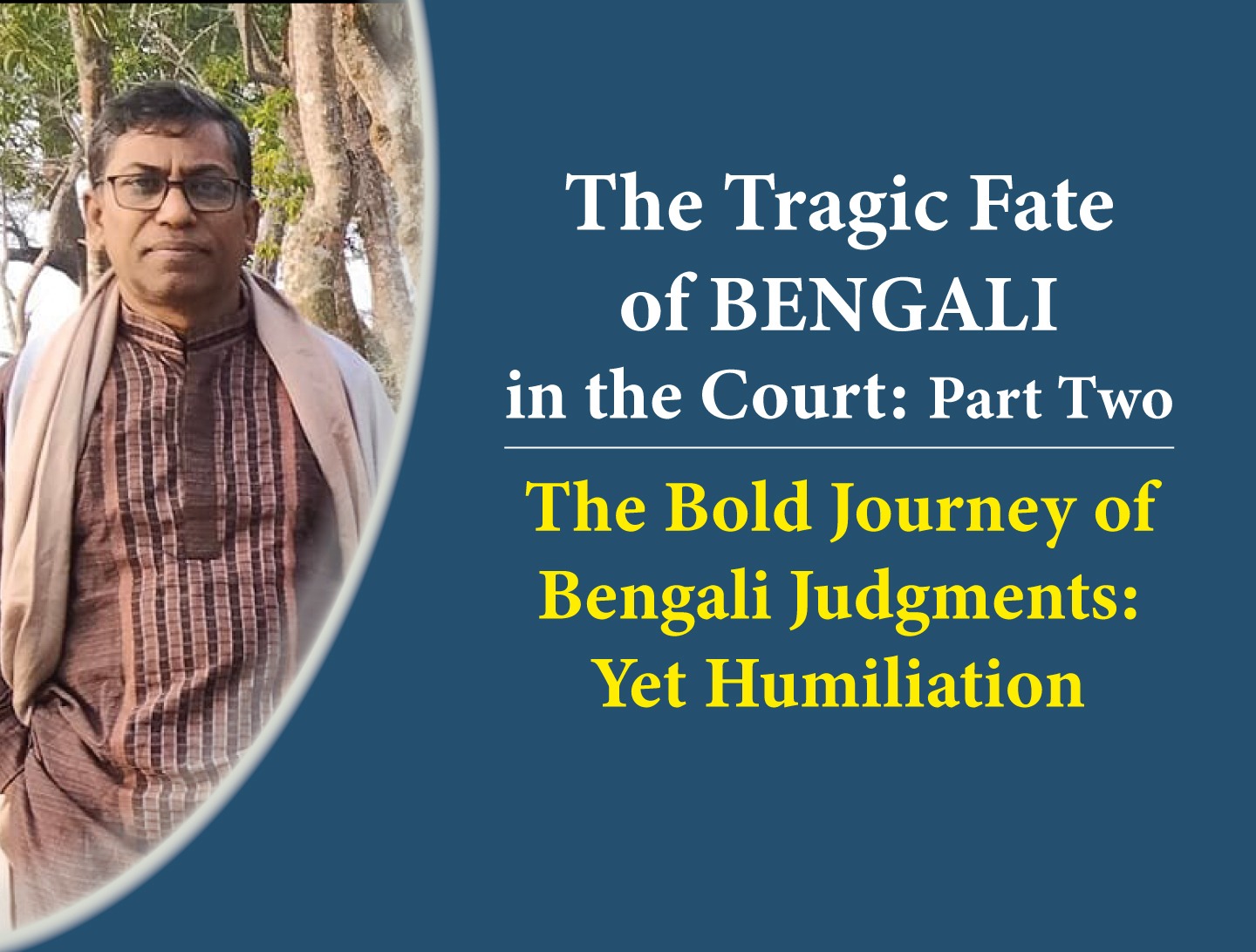
Prakash Biswas is a columinist, researcher, and legal expert. He currently serves as a Deputy Attorney General in the interim government. In the first part of his essay titled “The Tragic Fate of Bengali in the Court” he discusses the realities and obstacles regarding the use of the Bengali language in the judiciary.
Prakash Biswas has shown that if Bengali were used throughout the court system, the plain people would have easier access to legal services. However, the reality is that in the courts of a nation that once shed blood for its language, the mother tongue is now neglected.
In the first part of his essay, Prakash Biswas provided a detailed discussion on the status of the Bengali language in the courts, the legal obligations surrounding it, and the lack of implementation. However, the story does not end here. There have been attempts to write judgments in Bengali, but how successful have they been? Why has Bengali still not reached the desired level of usage? Despite taking several brave steps, why must it still face such harsh criticism? Has anyone ever truly felt the question deep within their hearts?
The Tragic Fate of Bengali in the Court: Part I
Judgment in Bangla: Why a Translation Centre is Necessary and How It Can Be Implemented
Currently, in India, the rulings of the Supreme Court are translated into 9 out of the 22 officially recognised languages. According to Article 348 of the Indian Constitution, English is mandatory for delivering judgments in the Supreme Court and High Courts, which is why they have implemented this translation system. As far as is known, AI (Artificial Intelligence) or MT (Machine Technology) is used to assist in the translation process. Such a translation system was also present in the Calcutta High Court in the past.
The Calcutta High Court was established in 1862. Shortly afterwards, in early 1867, Michael Madhusudan Dutt, having recently qualified as a barrister-at-law, began his legal career at the Calcutta High Court. However, he did not achieve much success in the profession. Therefore, in 1870, he left legal practice and accepted a job as an examiner in the Translation Department of the Calcutta High Court with a monthly salary of one thousand rupees. From this, it can be inferred that the Calcutta High Court had a translation department since its inception.
However, the question arises: the Calcutta High Court was under British rule, and English was the official language then, so why was a translation centre necessary? Bangladesh is independent now, and the state language is Bangla, so why is there a need for a translation centre here again? In a previous paragraph (in the first part), I mentioned that if a judge believes a judgment has international application, they may write the ruling in English. However, if it is written in Bangla, the necessity of a translation centre inevitably comes to the forefront.
A former Chief Justice once remarked that if a good translation management system could be established under the supervision of the Supreme Court, then judgments written in English could be translated into Bangla—especially those that the justices believe should be available in Bangla. This system could also work in the following manner—if a judge delivers a significant judgement in Bangla and believes it sets a new precedent, enriching jurisprudence or international legal research, they may send it to the translation centre for English translation. However, the concerned judge must provide a brief explanation at the end of the judgment, highlighting its significance and issue a certificate for translation.
Similarly, when a justice delivers an important judgement in English and believes that its Bangla translation is necessary for the general public’s understanding, they may follow the same procedure and send it to the centre for translation. This way, higher court judgments will be available in Bangla, and the translated versions of significant Bangla judgements will also reach an international audience, giving them a clear understanding of Bangladesh’s judiciary and its standards.
Obstacles to Bengali Judgments in the Enforcement of Foreign Contracts
Even after introducing a translation system, particular challenges may persist. According to a recent UN survey, Bangladesh ranks 189th out of 190 countries in the specific performance of commercial contracts. Trade agreements are typically signed with foreign companies or organisations and play a crucial role in the national economy. Investment is one of the primary tools for reducing unemployment in the country. To attract investment and create employment opportunities, the proper execution of commercial agreements is essential. However, if legal complications arise in enforcing these contracts, foreign investment will decline, leading to a rise in unemployment.
In this context, judgments concerning disputes over foreign trade agreements should be written in a language that is easily understandable to all concerned parties. In such cases, delivering judgments in English is both natural and logical. However, if a Bengali translation of such a judgment is required for the general public’s understanding, it may be done following the previously mentioned method.
Writing judgments in a language accessible to the general public is definitely a noble initiative and falls within a judge’s responsibilities. However, no compromise should be made in delivering well-reasoned, wise, and logical judgments for maintaining global judicial standards. Considering these factors, I have emphasised the necessity of a translation system for judgments.
If all judges attempt to write judgments in Bengali, the rulings must be clear, logical, and fair. An effective system should be established to translate judgments into both Bengali and English. To implement this, necessary steps may be taken in consultation with the government
Laws Exist, But So Do Obstacles
While the Constitution and other laws mandate the use of Bengali, the judiciary remains exempt from this requirement. While disposing of several civil petitions, the High Court delivered a landmark ruling on this issue on November 8, 1991. In its ruling, referencing Section 137(1) of the Code of Civil Procedure, the court held that using English in judicial proceedings—such as judgments, pleadings, and petitions— does not constitute a violation of law. Consequently, the established practice of using English in courts before enforcement of the ‘Bengali Language Implementation Act’ may lawfully continue.”
The judgment also includes an explanation on language usage, identifying three distinct categories — the state language, the government’s language, and the language of the judiciary:
1. State Language: The language used in all national affairs;
2. Government Language: The language of executive functions;
3. Court Language: The language of judicial proceedings.
Following this High Court ruling, the usage of Bengali was never made mandatory in lower courts. The issue of implementing Bengali in all spheres surfaces only during February [International Mother Language Month], with mere promises being made but no concrete measures taken. Even efforts to amend Section 137 of the Code of Civil Procedure, which stands as a barrier to the use of the mother tongue in courts, are not undertaken. Thus, these promises remain mere hot air, never touching the ground..
Law Commission’s Recommendation: No Effective Implementation
Although the Law Commission has recommended using Bengali in courts, the government has yet to take concrete action. The recommendation states that since Bengali is the state language under the Constitution, its use in courts should be mandated by law. Existing English laws must be translated into Bengali, and higher courts should conduct proceedings and deliver judgments in Bengali. Despite the Bengali Language Implementation Act, 1987 mandating the use of Bengali in courts and legal matters, English continues to dominate in the higher judiciary.
The recommendation further highlights that marginalised communities face discrimination when judgments are written in English, as their inability to understand the language puts them at a disadvantage. Therefore, court proceedings should follow the language of the masses to ensure people can comprehend their rights and access justice without barriers.
The Law Commission report cites Article 3 of the Constitution and the Bengali Language Implementation Act, 1987, which require all executive, legislative, and judicial functions to be conducted in Bengali. But, in the Hasmotullah vs. Azmeri Bibi & Others case, the High Court ruled that under Section 137(2) of the Code of Civil Procedure, the government cannot declare the use of Bengali in court proceedings.
The recommendation notes that two sections of the Code of Criminal Procedure and one section of the Code of Civil Procedure continue to hinder the use of Bengali in courts. Despite no legal barriers, higher courts have not adopted Bengali.
The Bold Journey of Bengali Judgments: Yet Humiliation
Recent history shows that the late Justice Amirul Islam Chowdhury was among the first judges to begin writing orders and judgments in Bengali. However, these were never reported in law journals.
In February 1998, a bench comprising Justice Kazi Ebadul Haque and Justice Hamidul Haque delivered a landmark judgment in Bengali in the case of Nazrul Islam vs. The State, reported in the Dhaka Law Reports (50 DLR, Page 103).
On the same day, Justice Hamidul Haque authored another Bengali judgment in the criminal revision case Abdul Aziz vs. Sekandar Ali (50 DLR, Page 111). Afterwards, in the case Habibur Rahman vs. Serajul Islam, Justice Kazi Ebadul Haque delivered a Bengali judgement, published in 51 DLR, Page 147.
A significant ruling on when police testimony can be considered credible in criminal cases was explained in Bengali in Abdur Razzak vs. The State (51 DLR, Page 83).
Furthermore, Justice Hamidul Haque and Justice Abdul Quddus authored several precedent-setting Bengali judgments. More recently, Justice ABM Khairul Haque delivered multiple Bengali judgments in the higher judiciary. On February 11, 2007, in Matiur Rahman Mia vs. Achia Khatun & Others, he proved that there is no legal barrier to using Bengali in higher courts.
However, the reality is that justices in the higher courts almost never write judgments in Bengali. In fact, on February 14, 2007, a bail petition written in Bengali was even removed from the cause list, reflecting the true state of the use of Bengali in court.
The statement must be written in the witness’s native language
The High Court has rulings suggesting that a witness’s testimony should be recorded in the witness’s native language, whether a regional dialect or the standard form. Those who write in English believe they are as proficient as native speakers and that English is their sole realm of thought. However, their numbers are steadily declining.
I cannot refrain from mentioning a professional anecdote from the life of a senior criminal lawyer. In a Dhaka court, a man from Manikganj was giving his testimony as the plaintiff in a case of fish theft—
“তখন বিয়ান বেলা। ঘুম থিকা উইঠা অভ্যাস মতো চকের দিকে আটতে থাকি। পরেই ডাঙ্গার চালা। ডাঙ্গার পারে খাড়ায়া দেহি কি দূরে কয়েকজন দবুড় (to run) দিয়া পলাইয়া যাইতেছে। আমার রেইঞ্জের মইদ্যে তারা ছিল না। ডাঙ্গার পাড়ের চ্যারদিকে পানি থিকা জালে ওঠা তোলা ক্যাদা আর ক্যাদা। পাড়ে পানি ভেজা ক্যাদা মাখা একটি মাছ দরার জাল পাই।” (It was early morning. I woke up and, as usual, began walking toward the field. Then came the embankment slope. Standing on the embankment’s edge, I saw several people running away in the distance. They weren’t in my range. All around the embankment, there was wet mud from the water clinging to the fishing nets. On the shore, I found a fish-catching net smeared with water-soaked mud.)
When the judge attempted to record the testimony in English, he translated the word ‘দবুড়’ (dobur–to run) as ‘chasing’ (pursuing). However, when the testimony was explained to the plaintiff, he exclaimed, ‘I never said that!’ Following a petition by his lawyer, the judge struck out the disputed lines. This caused unnecessary delays, frustrating both the legal counsel and litigants.
So, what is the solution?
To ensure the use of the Bengali language in courts, amending the Code of Civil Procedure is essential, and enacting a new law for the use of Bengali in higher courts is equally necessary. Discussions with several jurists reveal that if Bengali is introduced in higher courts, it would help the general public better understand court judgments, while also gaining international recognition for those judgments.
A standardised app can be developed for accurate legal writing in Bengali, which can serve as a basis for drafting petitions and judgments in Bengali. Furthermore, an online version of a comprehensive Bengali grammar for legal use could be initiated.
But the question remains—who will bell the cat?
These matters, in my opinion, deserve renewed attention from the apex court.
Prokash Biswas, Deputy Attorney General for Bangladesh
Author, Researcher, and Legal Expert
Discover more from Critics - Anticritics
Subscribe to get the latest posts sent to your email.